An investment in knowledge pays the best interest – Benjamin Franklin

Nobody knows the true number of viruses affecting Linux, but it is probably less than 1,000, and that’s the total since Linux was created back in the early 1990s! At the time of this writing, there are relatively few Linux viruses in the wild, which is to say, actively infecting computers. However, there can be … Read more
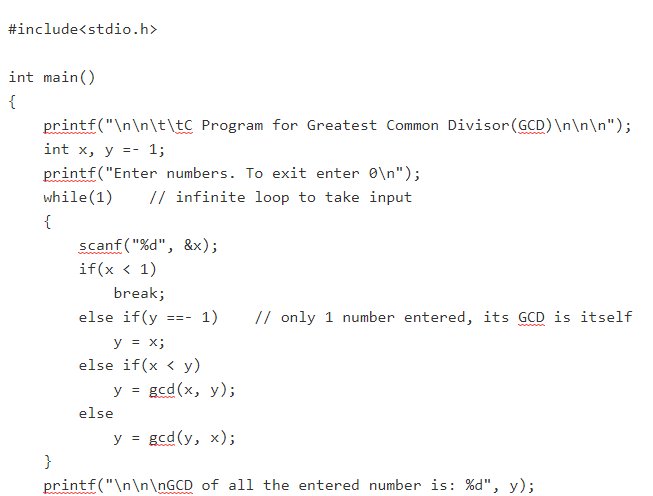
C Program to find GCD of N Numbers #include<stdio.h> int main() { printf(“\n\n\t\tC Program for Greatest Common Divisor(GCD)\n\n\n”); int x, y =- 1; printf(“Enter numbers. To exit enter 0\n”); while(1) // infinite loop to take input { scanf(“%d”, &x); if(x < 1) break; else if(y ==- 1) // only 1 number entered, its GCD is … Read more
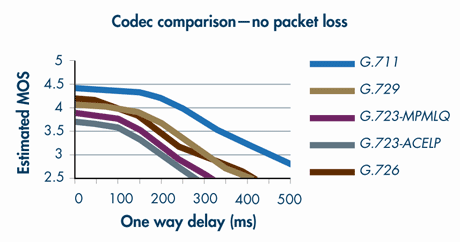
G.711 Codec G.711 is a codec that was introduced by ITU in 1972 for use in digital telephony. The codec has two variants: A-Law is being used in Europe and in international telephone links, uLaw is used in the U.S.A. and Japan. G.711 uses a logarithmic compression. It squeezes each 16-bit sample to 8 bits, thus it achieves a … Read more
The Ubuntu notification area (the equivalent of the Windows system tray) at the top right of the screen contains a program that automatically monitors the package repositories and tells you when updates are available. This is the Update Manager. If you haven’t yet updated your system, this icon will have probably turned into a white … Read more
As you start to understand how Ubuntu works, you’ll become more and more aware of commonsense methods that will protect your system. However, we’ll outline a few of these now to get you started: •Entering your password: Be very wary if you’re asked to enter your password (outside of initial login, of course). You’ll be … Read more
Although users are the subject of another chapter, allow us to introduce the distinction between the root user account and ordinary users, because this distinction is the foundation on which much of the security model is based. For a more in-depth discussion on the matter. Linux makes use of something called the root user account. … Read more
If you’ve switched to Ubuntu from Windows, there’s a very good chance that the security failings of Windows featured in your decision. Windows 7 contains many improvements, but Microsoft’s record on security over the past few years has not been great. New and serious security warnings have appeared on an ongoing basis, and even now, … Read more
Depending on the degree to which your computer supports power-saving functionality, Ubuntu will let you configure your display to go into standby mode after a certain amount of time and will also allow you to configure your notebook to enter sleep (standby) mode. In addition, if you use a notebook computer, Ubuntu might let you … Read more
Generally speaking, your sound card shouldn’t require any additional configuration and should worknimmediately after you install Ubuntu. The icon for the volume control applet is located at the top right of the Ubuntu Desktop, and it offers a quick way to control the master volume. However, if you want to change your balance or microphone … Read more