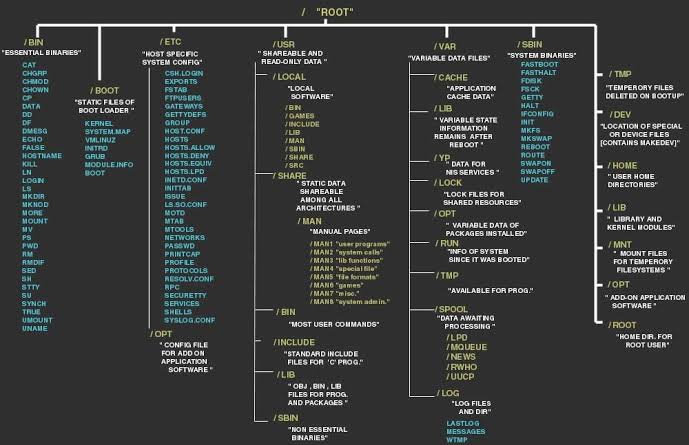
the Linux file tree

This post takes a look at the most common directories in the Linux file tree. It also shows that on Unix everything is a file. filesystem hierarchy standard Many Linux distributions partially follow the Filesystem Hierarchy Standard. The FHS may help make more Unix/Linux file system trees conform better in the future. The FHS is … Read more
working with files

In this post we learn how to recognise, create, remove, copy and move files using commands like file, touch, rm, cp, mv and rename. all files are case sensitive Files on Linux (or any Unix) are case sensitive. This means that FILE1 is different from file1, and /etc/hosts is different from /etc/Hosts (the latter one … Read more

working with linux directories

This module is a brief overview of the most common commands to work with directories: pwd, cd, ls, mkdir and rmdir. These commands are available on any Linux (or Unix) system. pwd The you are here sign can be displayed with the pwd command (Print Working Directory). Go ahead, try it: Open a command line … Read more

LINUX LICENSING

This post briefly explains the different licenses used for distributing operating systems software. about software licenses There are two predominant software paradigms: Free and Open Source Software (FOSS) and proprietary software. The criteria for differentiation between these two approaches is based on control over the software. With proprietary software, control tends to lie more with … Read more

LINUX DISTRIBUTIONS

This post gives a short overview of current Linux distributions. A Linux distribution is a collection of (usually open source) software on top of a Linux kernel. A distribution (or short, distro) can bundle server software, system management tools, documentation and many desktop applications in a central secure software repository. A distro aims to provide … Read more

Linux history

This post briefly tells the history of Unix and where Linux fits in.   1969 All modern operating systems have their roots in 1969 when Dennis Ritchie and KenThompson developed the C language and the Unix operating system at AT&T Bell Labs.They shared their source code (yes, there was open source back in the Seventies) … Read more

WAYS TO PROTECT CYBER TERRORISM

“SOME WAYS TO PROTECT CYBER TERRORISM” Employ Strong Passwords: As simple as this sound, it is one of the most overlooked methods of keeping systems safe. There are a number of freely available tools that ‘guess’ passwords — a very common technique referred to as ‘brute force cracking. These programs work by repeatedly attempting to … Read more

CYBER TERRORISM

CYBER TERRORISM- THE DARK SIDE OF THE WEB WORLD “Cyber terrorism is the premeditated use of disruptive activities, or the threat thereof, in cyber space, with the intention to further social, ideological, religious, political or similar objectives, or to intimidate any person in furtherance of such objectives.” Computers and the internet are becoming an essential … Read more