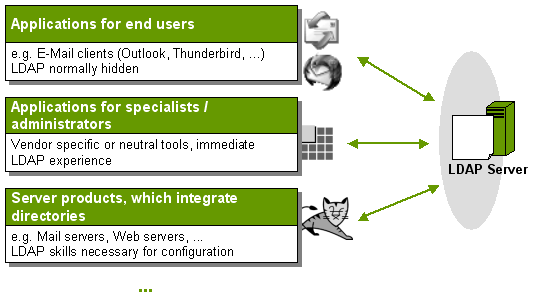
In this article we will learn about step by step installation and configuration of LDAP.
To learn about Basic of LDAP, Click here.
http://blog.eduguru.in/ldap-basic-of-open-ldap-introduction-to-ldap/
Install Open LDAP:
# yum install *openldap* -y
Start the Services:
# chkconfig –levels 235 ldap on
# service ldap start
Create LDAP root user password:
# slappasswd
New password:
Re-enter new password:
Update /etc/openldap/slapd.conf for the root password:
# vi /etc/openldap/slapd.conf
#68 database bdb
#69 suffix “dc=t4test,dc=com”
#70 rootdn “cn=Manager,dc=t4test,dc=com”
#71 rootpw {SSHA}cWB1VzxDXZLf6F4pwvyNvApBQ8G/DltW
Restart Services:
# service ldap restart
Create a test user:
# useradd test1
# useradd test2
Set User’s Password:
# passwd test1
Changing password for user test1.
New UNIX password:
Retype new UNIX password:
passwd: all authentication tokens updated successfully.
# passwd test2
Changing password for user test2.
New UNIX password:
Retype new UNIX password:
passwd: all authentication tokens updated successfully
Repeat the same for the rest of users.
Migrate local users to LDAP
# grep root /etc/passwd > /etc/openldap/passwd.root
# grep test1 /etc/passwd > /etc/openldap/passwd.test1
# grep test2 /etc/passwd > /etc/openldap/passwd.test2
Update default settings on file /usr/share/openldap/migration/migrate_common.ph
#71 $DEFAULT_MAIL_DOMAIN = “t4test.com”;
#74 $DEFAULT_BASE = “dc=t4test,dc=com”;
Convert passwd.file to ldif (LDAP Data Interchange Format) file
#/usr/share/openldap/migration/migrate_passwd.pl /etc/openldap/passwd.root /etc/openldap/root.ldif
#/usr/share/openldap/migration/migrate_passwd.pl /etc/openldap/passwd.test1 /etc/openldap/test1.ldif
#/usr/share/openldap/migration/migrate_passwd.pl /etc/openldap/passwd.test2 /etc/openldap/test2.ldif
Update root.ldif file for the “Manager” of LDAP Server
# vi /etc/openldap/root.ldif
#1 dn: uid=root,ou=People,dc=t4test,dc=com
#2 uid: root
#3 cn: Manager
#4 objectClass: account
Create a domain ldif file (/etc/openldap/t4test.com.ldif)
# cat /etc/openldap/t4test.com.ldif
dn: dc=t4test,dc=com
dc: t4test
description: LDAP Admin
objectClass: dcObject
objectClass: organizationalUnit
ou: rootobject
dn: ou=People, dc=t4test,dc=com
ou: People
description: Users of t4test
objectClass: organizationalUnit
Import all users in to the LDAP
Add the domain ldf file:
# ldapadd -x -D “cn=Manager,dc=t4test,dc=com” -W -f /etc/openldap/t4test.com.ldif
Enter LDAP Password:
adding new entry “dc=t4test,dc=com”
adding new entry “ou=People, dc=t4test,dc=com”
Add the users:
# ldapadd -x -D “cn=Manager,dc=t4test,dc=com” -W -f /etc/openldap/root.ldif
Enter LDAP Password:
adding new entry “uid=root,ou=People,dc=t4test,dc=com”
adding new entry “uid=operator,ou=People,dc=t4test,dc=com”
Repeat this for all the user.
Restart the LDAP service
# service ldap restart
Print all the user information:
# ldapsearch -x -b ‘dc=t4test,dc=com’ ‘(objectclass=*)’
It’s very straightforward to find out any matter on web as
compared to books, as I found this article at this web
site.